The .vs Series
This series began as a way of naming distinctions that are often quietly blurred in modern dance culture. Not to set up oppositions, and not to suggest that one side is right and the other wrong, but to slow things down enough to see what is actually being done, and what is being lost along the way.
Over time, certain ideas have come to be treated as interchangeable. Timing is spoken about as time. Power is confused with effect. Movement is mistaken for meaning. These pairings sit close together, and from a distance they can look the same. From the inside, they are not.
Each entry in this series takes one such pairing and holds it still. The intention is not to instruct or correct, but to bring clarity. These distinctions have been shaped on the floor, in practice rooms, and in competitive environments, and later through teaching, judging, and watching others develop.
They come from experience, not theory.
You can read these pieces in any order. Some may resonate immediately, others may take longer to settle. Together, they form a way of thinking about dance that values purpose over display, listening over noise, and depth over accumulation.
This page exists so these ideas have a permanent home, outside the pace and pressure of social media.
Timing vs Time
Timing is taught, counted, and agreed upon. It gives dancers a shared framework. It allows movement to be organised, rehearsed, and coordinated. Within that structure, everyone knows where they are.
Time is different. Time is experienced.
Timing is not the problem. It is necessary. Without it, dancers cannot practise together, communicate clearly, or build anything coherent. Structure provides the conditions in which dancing can happen at all.
It is shaped by how a dancer listens to the music, how they sense its phrasing, and how they choose to inhabit each moment. Time does not exist on its own. It only exists in relation to something else: the music, the partner, the space between actions.
In dance, timing allows things to happen together. But time determines whether those actions feel connected to what is actually being danced. Two dancers may move on exactly the same count, yet only one appears to be inside the music rather than alongside it.
When time is not used, dancing can feel rushed even when it is accurate. Movement arrives correctly, but without depth or presence. Musicality may look active, yet feel strangely absent. The steps are there, but they do not settle.
Using time allows movement to align more deeply with the music. It creates space for movement to open, stretch, and resolve. The focus shifts away from placing steps correctly and toward shaping what happens between them.
As dancers move beyond simply following counts and begin shaping time, movement starts to listen. And it is here that timing stops being purely technical and becomes expressive, personal, and unmistakably their own.

Power vs Effect
Power is often associated with strength, projection, and certainty. It is visible and easily recognised, and for that reason it is frequently rewarded. Power looks convincing. It suggests confidence and command.
Effect is quieter.
Effect is what happens when movement is shaped with sincerity rather than force. It is not about how much energy is used, but about what is communicated and received. A dancer may apply considerable power and leave very little behind. Another may do far less, and yet invite others into a shared emotional space.
Power is often favoured because it reads quickly. It travels across large spaces, registers clearly from a distance, and creates an immediate impression. Effect, by contrast, is slower to reveal itself. It depends on contrast, timing, and the ability to shape attention. This makes it easier to overlook, particularly in environments that reward immediacy over resonance.
When dancing is sincere, it allows the audience to see the world through the dancer’s eyes. Not because the movement is impressive, but because it is inhabited. The gestures are not performed at the viewer, they are offered. That is where effect begins.
This distinction matters because power can exist without connection. It can dominate a space while remaining closed. Effect, by contrast, depends on openness. It requires the dancer to consider not only what they are doing, but how it is felt beyond themselves.
The most lasting performances are rarely the loudest. They are the ones that resonate after the movement has finished. They stay because something genuine was shared, not because something impressive was shown.
This is not unique to dance. Whether in music, writing, or any creative form, effect arises when technique serves expression rather than eclipsing it. When the work connects, it extends beyond the moment of performance.
Power shows what can be done.
Effect reveals what has been felt.

Hearing vs Listening
Hearing is the presence of sound. The music is audible. The beat is clear. It exists whether or not attention is given to it.
Listening requires attention.
It means opening the ear to more than the obvious. To notes, pauses, shifts in intensity, and the subtle changes that give the music its shape and breath. Listening asks for involvement, not just awareness.
Hearing allows information to be received. Listening asks for engagement. It requires the dancer to stay with what is unfolding, rather than anticipating what comes next. This attention cannot be automated. It has to be renewed moment by moment.
Listening is not about adding more movement. It changes how movement is shaped, not simply when it happens. The difference is not in quantity, but in relationship.
When dancers are only hearing the music, movement is often organised around counts and choreography. Steps arrive according to their timing, but the music remains something external. It is followed, rather than entered.
When dancers truly listen, attention shifts. Movement begins to respond rather than be placed on the music. It settles into the sound instead of sitting on top of it. The dance starts to breathe with the music rather than run alongside it.
In that attention, dance becomes more personal. Not because it is designed to be different, but because listening itself is individual. No two dancers hear in exactly the same way.
This is where interpretation begins.
And where movement becomes genuinely their own.

Noticed vs Remembered
Many things are noticed in a dance performance. Some register immediately.
But being noticed is not the same as being remembered.
What stays with us is rarely the detail. It is the feeling we are left with when we think back to the performance. The sense that something felt true.
Each of us will have our own preferences. Different dancers or couples will resonate with us in different ways, often long after the results themselves are forgotten. What lingers is not always what drew attention in the moment, but what made sense within the whole.
Being noticed belongs to the moment.
Being remembered belongs to time.

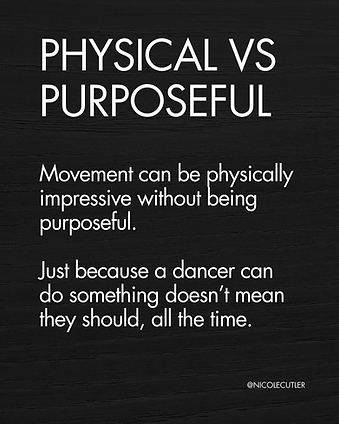
Physical vs Purposeful
Physical ability is easy to see in dance. Strength, flexibility, speed, stamina. These qualities register quickly, and they are often rewarded. They create impact, signal effort, and demonstrate what a body can do.
But bodies are not identical, and they are not interchangeable. What is asked of them carries a cost, and not all bodies respond in the same way. Capacity, recovery, resilience, and longevity vary far more than competitive aesthetics tend to acknowledge.
When physical output becomes the primary focus, intention can slip out of view. Movement may still look impressive, but something begins to narrow. Musical awareness becomes harder to sustain, phrasing flattens, and with it a dancer’s individual identity can start to blur. The body is busy, but the dancing is less considered.
This matters because physical demand accumulates. What can be produced in short bursts is not always sustainable over time. When dancers feel pressure to operate continually at maximum capacity, physicality becomes something to endure rather than something to shape. The cost is not always immediate, but it is rarely absent.
Another layer of this distinction lies in how bodies are being asked to move. Increasingly, training environments reward a single physical language: force-driven, expansive, and externally powerful. Much of today’s movement language aligns around male physiology, where projection, strength, and assertive action sit more easily within the body being used, even as our understanding of physiological difference has increased elsewhere.
As physical approach narrows, physicality can begin to replace physiology and character. Dances start to resemble one another, not because the vocabulary is shared, but because the physical logic behind them has converged.
One way this loss of specificity shows itself is in how different dances begin to blur. A Samba and a Cha Cha may share athletic demands, but they do not ask the body to speak in the same way. A Cha Cha and a Rumba may share vocabulary, but they do not carry the same emotional weight or temporal relationship to the music. When physical capacity becomes the organising principle, actions grow larger and more forceful across all dances, not because the music or character requires it, but because the body is producing them.
Purposeful movement comes from a different place. It is shaped by what the movement requires, not by how much the body can do. It works with the body’s capacity and physiology rather than against it, using effort where it matters instead of everywhere at once. Physicality remains present, but it is directed accordingly.
Purpose introduces choice. It allows the dancer to decide when strength serves the music, when speed clarifies intention, and when restraint allows something deeper to emerge. In this context, physical ability is not diminished. It is refined.
This is not about doing less. It is about understanding what the dance needs, and what simply exhausts the body without adding meaning. Over time, that understanding is what allows movement to remain clear, individual, and present.
Physicality shows what a body is capable of.
Purpose reveals what the dance is actually asking for.